
Calling All (Future) Writers!
How to get started on the book you want to write, or how I realized at NCTE teachers want to get started on their book!

I am still in that roller-coaster feeling of the ups and downs after leaving an inspirational conference. Yes, what goes up must come down, and I’m still looking through the notes and processing all of the wonderful things I discovered in Denver. I would just say to creative writers who teach, take a break from AWP and try NCTE. Everyone is talking about fiction, memoir, and poetry, but especially the teaching aspect in which we all face other people trying to make their dreams come true.
This is my first conference which included K through 12 teachers and I absolutely embraced it. It did my heart good to see that so many teachers of English are dedicated to our children.
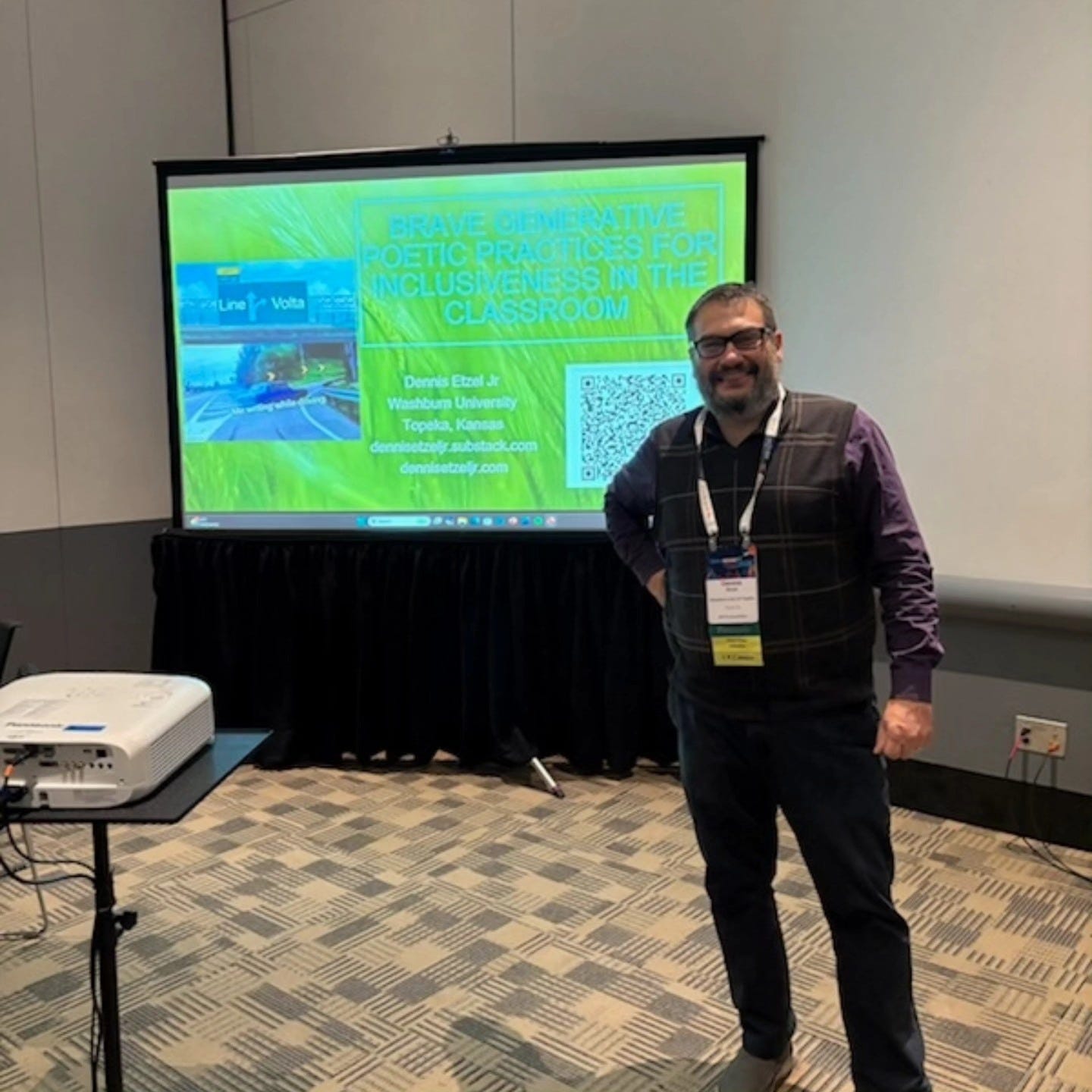
photo by Melanie Burdick
[
And in this year’s theme of dreaming boldly, I met educators wishing to write poetry. Dr Danny Wade, a colleague of mine at Washburn University, is part of a committee dedicated to teaching poetry writing with K-12 students. He also co-facilitates a poetry writing group for teachers every year, this year on Saturday night.
As he helps others to lean into writing in and out of the classroom, Dr. Wade also confided, “I’m ready to write my book. I’ve been teaching ya novels for so long, I’m ready to write my own.”
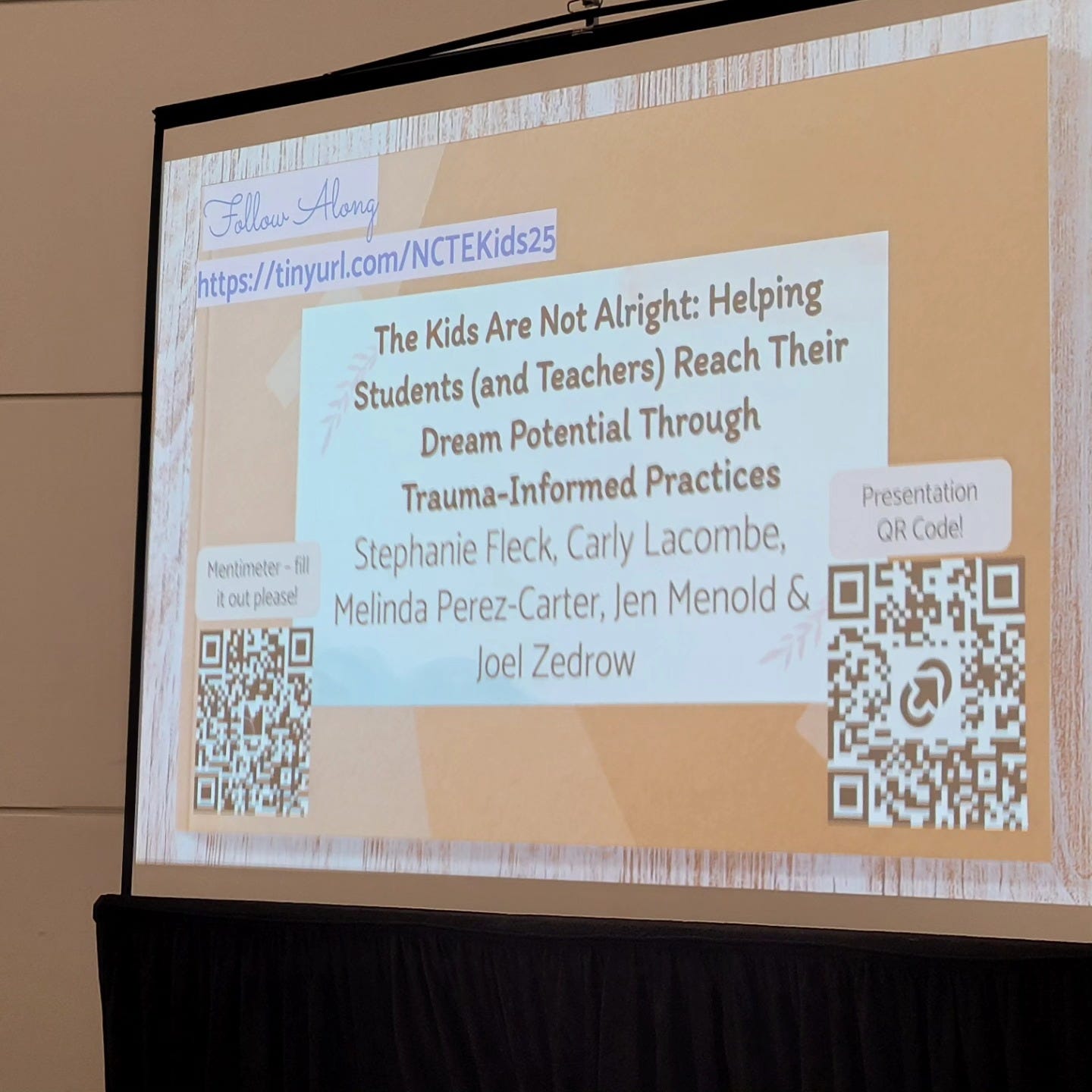
I had discussions with several people I know and don’t know about how they are ready to get into writing. In fact, two of my colleagues will join my spouse and her friend for a romance novel writing support group to meet every month.
I’m also happy to share that I had to stop writing fiction because of one certain character who woke me up three nights in a row to let me know he wouldn’t act the way I wrote him.
That’s what eased me into thinking of myself as an eavesdropper when it comes to writing stories. Once you get your character developed, you don’t have to worry about what they will say or do. You simply listen like a reporter and write down everything that happens.
So when students take my fiction writing class, I do the same as I do with poetry writing or memoir writing. You come up with rituals for writing so you can lift off the weight of writing and not resort to cliche, safe writing.
Here are a few of the rituals I lead students through:
Finding the power to write
Find a “power place” for writing that is not inside home or office. Maybe it is outside, in a coffee house, or otherwise? Don headphones with power music and power-write for five minutes based on one of these prompts or who you envision your main character to be. Basically, [pronoun] is the type that . . .
“she is the type that . . . “
“he is the type that . . . ”
“they are the type that . . . ”
Then you can choose or even accept all of the things you wrote down and developing the character. You might even think of them inside of a setting to see what happens as far as plot is concerned.
Finding the fire to write
I lead students to the fireplace in the Union. Before we go, I remind students that if they feel uneasy or triggered, to feel free to step away and do their own thing as I know people who have been traumatized by fire.
I have them write notes about what they see when they look at the fire. Some of them even notice that it’s a gas lit fire so even though it is an element, there’s something “artificial” or “constructed”.
Selecting an new or existing character, make notes on the first things that come to mind. In other words, as you read each of these questions, listen for the answers instead of coming up with them. Think of this like stream of consciousness writing.
What was the first time your character saw fire?
Is there a time your character was ever hurt by fire?
How does your character feel about summers?
What is a favorite time your character had sitting by a fire?
Of course, this can be done with any element. It does work best when you create your own immersion into whatever you choose, like snow, rain, trees.
Think of three generations. Think of a gift that could get passed down. Then develop a table of contents for each of the chapters.
Table of Contents
“The Eighth Birthday” Kay gives her daughter Alicia the bike on her eighth birthday, remembering her mother Heidi
“Handed Down” Heidi gives Kay (her daughter) her bike when she turns eight
“What is Protected, What is Stolen” Kay is twenty—in an apartment, someone steals bike in Topeka
“Sacrifices Redux” Kay is mad at Heidi for moving to Lawrence when Kay turned 18, she’s on her own with her baby
“An Old Friend” Mother (Heidi) finds bike at garage sale in Lawrence, priced as “antique,” returns to Topeka to return to Kay
“Sacrifices Cycle” (bad pun) Mother (Heidi) given bike when she was a girl, her mother saved up to purchase
[
These are a few of the rituals for writing. I think the biggest ritual one could develop for writing is just that, to find the time to do it. Could someone do it after reading a chapter of a book? For example, before stopping reading at a certain time, move that time up so you have 10 minutes just to get something written.
Think of writing as self care. Because it is! You will feel a lot better even just writing for 5 or 10 minutes. If you can take those 5-10 minute moments and let them accumulate, you’re getting somewhere.
It is hard to start writing! It’s hard to get back into writing after stopped. It’s just things to know. And that writing is tough. You are going to have to revise somehow. But maybe that’s when you are done writing.
I know that I like to revise when everything is done, so I try to find time to mix it up, revise when I’m not necessarily in revision mode or time.
Thanks for reading, because having a substack helps with writing, too. I love this community.
Aha! I just need to actually listen to the voices in my head. Eureka!!😇
Great information!